•  
Red Spider Nebula

Red Spider Nebula

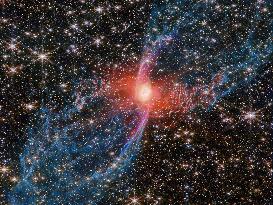
Handout photo dated on October 26, 2025 shows Red Spider Nebula. Using its Near-InfraRed Camera (NIRCam), NASA’s James Webb Space Telescope captured never-before-seen details of the Red Spider Nebula, a planetary nebula, in this image released on Oct. 26, 2025. NIRCam is Webb’s primary near-infrared imager, providing high-resolution imaging and spectroscopy for a wide variety of investigations. Webb’s new view of the Red Spider Nebula reveals for the first time the full extent of the nebula’s outstretched lobes, which form the ‘legs’ of the spider. These lobes, shown in blue, are traced by light emitted from H2 molecules, which contain two hydrogen atoms bonded together. Stretching over the entirety of NIRCam’s field of view, these lobes are shown to be closed, bubble-like structures that each extend about 3 light-years. Outflowing gas from the center of the nebula has inflated these massive bubbles over thousands of years. Photo by ESA/Webb, NASA & CSA, J. H. Kastner (Rochester Institute of Technolo via ABAC

  •  

[Breaking News]Japan launches H2A rocket

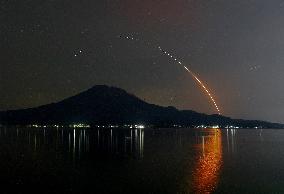
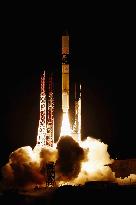
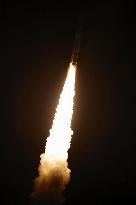
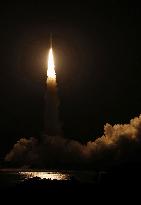
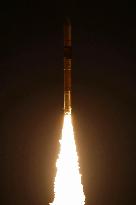
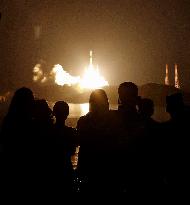
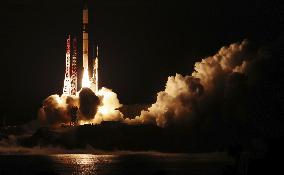
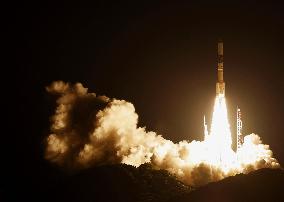
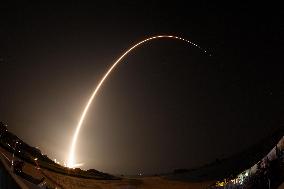
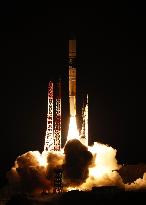
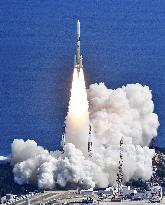
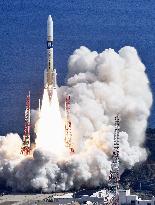
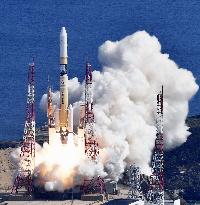
MINAMITANE, Japan, June 29 Kyodo - A Japanese H2A rocket, carrying a satellite for greenhouse gas and water cycle observation, is launched from the Tanegashima Space Center in Kagoshima Prefecture, southwestern Japan, in the early hours of June 29, 2025, the 50th and final mission of the rocket. (Kyodo)

  •  
Japan launches H2A rocket

Japan launches H2A rocket

A Japanese H2A rocket, carrying a satellite for greenhouse gas and water cycle observation, is launched from the Tanegashima Space Center in Kagoshima Prefecture, southwestern Japan, in the early hours of June 29, 2025, the 50th and final mission of the rocket.

  •  
Japan launches H2A rocket

Japan launches H2A rocket

A Japanese H2A rocket, carrying a satellite for greenhouse gas and water cycle observation, is launched from the Tanegashima Space Center in Kagoshima Prefecture, southwestern Japan, in the early hours of June 29, 2025, the 50th and final mission of the rocket.

  •  
Japan launches H2A rocket

Japan launches H2A rocket

A Japanese H2A rocket, carrying a satellite for greenhouse gas and water cycle observation, is launched from the Tanegashima Space Center in Kagoshima Prefecture, southwestern Japan, in the early hours of June 29, 2025, the 50th and final mission of the rocket.

  •  
Japan launches H2A rocket

Japan launches H2A rocket

A Japanese H2A rocket, carrying a satellite for greenhouse gas and water cycle observation, is launched from the Tanegashima Space Center in Kagoshima Prefecture, southwestern Japan, in the early hours of June 29, 2025, the 50th and final mission of the rocket.

  •  
Japan launches H2A rocket

Japan launches H2A rocket

A Japanese H2A rocket, carrying a satellite for greenhouse gas and water cycle observation, is launched from the Tanegashima Space Center in Kagoshima Prefecture, southwestern Japan, in the early hours of June 29, 2025, the 50th and final mission of the rocket.

  •  
Japan launches H2A rocket

Japan launches H2A rocket

A Japanese H2A rocket, carrying a satellite for greenhouse gas and water cycle observation, is launched from the Tanegashima Space Center in Kagoshima Prefecture, southwestern Japan, in the early hours of June 29, 2025, the 50th and final mission of the rocket.

  •  
Japan launches H2A rocket

Japan launches H2A rocket

A Japanese H2A rocket, carrying a satellite for greenhouse gas and water cycle observation, is launched from the Tanegashima Space Center in Kagoshima Prefecture, southwestern Japan, in the early hours of June 29, 2025, the 50th and final mission of the rocket.

  •  
Japan launches H2A rocket

Japan launches H2A rocket

A Japanese H2A rocket, carrying a satellite for greenhouse gas and water cycle observation, is launched from the Tanegashima Space Center in Kagoshima Prefecture, southwestern Japan, in the early hours of June 29, 2025, the 50th and final mission of the rocket.

  •  
Japan launches H2A rocket

Japan launches H2A rocket

A Japanese H2A rocket, carrying a satellite for greenhouse gas and water cycle observation, is launched from the Tanegashima Space Center in Kagoshima Prefecture, southwestern Japan, in the early hours of June 29, 2025, the 50th and final mission of the rocket.

  •  
Japan launches H2A rocket

Japan launches H2A rocket

A Japanese H2A rocket, carrying a satellite for greenhouse gas and water cycle observation, is launched from the Tanegashima Space Center in Kagoshima Prefecture, southwestern Japan, in the early hours of June 29, 2025, the 50th and final mission of the rocket.

  •  
Japan launches H2A rocket

Japan launches H2A rocket

A Japanese H2A rocket, carrying a satellite for greenhouse gas and water cycle observation, is launched from the Tanegashima Space Center in Kagoshima Prefecture, southwestern Japan, in the early hours of June 29, 2025, the 50th and final mission of the rocket.

  •  
Japan launches H2A rocket

Japan launches H2A rocket

A Japanese H2A rocket, carrying a satellite for greenhouse gas and water cycle observation, is launched from the Tanegashima Space Center in Kagoshima Prefecture, southwestern Japan, in the early hours of June 29, 2025, the 50th and final mission of the rocket.

  •  
Japan launches H2A rocket

Japan launches H2A rocket

A Japanese H2A rocket, carrying a satellite for greenhouse gas and water cycle observation, is launched from the Tanegashima Space Center in Kagoshima Prefecture, southwestern Japan, in the early hours of June 29, 2025, the 50th and final mission of the rocket.

  •  

Int'l oil exhibition concludes in Iranian capital

STORY: Int'l oil exhibition concludes in Iranian capital SHOOTING TIME: May 13, 2024 DATELINE: May 14, 2024 LENGTH: 0:01:09 LOCATION: Tehran CATEGORY: ECONOMY SHOTLIST: 1. various of the 28th Iran International Oil, Gas, Refining, and Petrochemical Exhibition STORYLINE: The 28th Iran International Oil, Gas, Refining, and Petrochemical Exhibition, commonly referred to as Iran Oil Show 2024, concluded on Saturday in the Iranian capital of Tehran. According to Shana News Agency, the exhibition attracted 1,500 domestic firms and 250 companies from 12 countries including Russia, France, Japan, India, China, Austria, Argentina, and Belarus. Over the course of the four-day event, Iranian and foreign companies used the 70,000-square-meter exhibition space to exhibit their latest advancements and technologies in the oil industry. Numerous seminars, expert meetings, conferences, roundtables, and educational workshops were also conducted. Domestic firms and organizations signed a significant number of contracts a

  •  
(AmazingAnhui)CHINA-ANHUI-HEFEI-ENVIRONMENTAL BUSINESSES (CN)

(AmazingAnhui)CHINA-ANHUI-HEFEI-ENVIRONMENTAL BUSINESSES (CN)

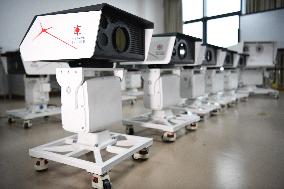
(240126) -- HEFEI, Jan. 26, 2024 (Xinhua) -- This photo taken on Jan. 17, 2024 shows quick testing devices for leaking gas at Hefei CAS InfraRed Precise Instrument Co., Ltd. in the China Environment Valley in Hefei, east China's Anhui Province. Dubbed an "ecological environment hospital," China Environment Valley in Hefei has become a thriving hub for environmental businesses. By the end of 2023, it housed over 400 enterprises dealing with fields related to water, atmosphere, solid waste, environmental modification and monitoring. Beyond just providing a physical space, the Valley fosters a collaborative ecosystem where companies dive deeper than mere participation. They actively explore innovative management strategies, leading to a double win: enhanced environmental quality and increased efficiency. The Valley's success hinges on a well-oiled machinery. The local government acts as a magnet for environmental protection enterprises, while a dedicated research institute fuels the ecosystem with cutting-

  •  
(AmazingAnhui)CHINA-ANHUI-HEFEI-ENVIRONMENTAL BUSINESSES (CN)

(AmazingAnhui)CHINA-ANHUI-HEFEI-ENVIRONMENTAL BUSINESSES (CN)

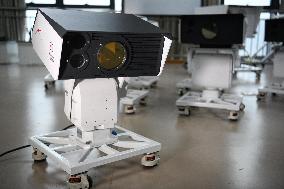
(240126) -- HEFEI, Jan. 26, 2024 (Xinhua) -- This photo taken on Jan. 17, 2024 shows a quick testing device for leaking gas at Hefei CAS InfraRed Precise Instrument Co., Ltd. in the China Environment Valley in Hefei, east China's Anhui Province. Dubbed an "ecological environment hospital," China Environment Valley in Hefei has become a thriving hub for environmental businesses. By the end of 2023, it housed over 400 enterprises dealing with fields related to water, atmosphere, solid waste, environmental modification and monitoring. Beyond just providing a physical space, the Valley fosters a collaborative ecosystem where companies dive deeper than mere participation. They actively explore innovative management strategies, leading to a double win: enhanced environmental quality and increased efficiency. The Valley's success hinges on a well-oiled machinery. The local government acts as a magnet for environmental protection enterprises, while a dedicated research institute fuels the ecosystem with cutting

  •  
NASA’s Webb Finds Signs of Possible Aurorae on Isolated Brown Dwarf

NASA’s Webb Finds Signs of Possible Aurorae on Isolated Brown Dwarf

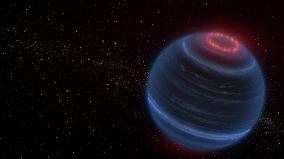
Handout photo - This artist concept portrays the brown dwarf W1935, which is located 47 light-years from Earth. Astronomers using NASA’s James Webb Space Telescope found infrared emission from methane coming from W1935. This is an unexpected discovery because the brown dwarf is cold and lacks a host star; therefore, there is no obvious source of energy to heat its upper atmosphere and make the methane glow. The team speculates that the methane emission may be due to processes generating aurorae, shown here in red. Infrared emission from methane suggests atmospheric heating by auroral processes. These findings are being presented at the 243rd meeting of the American Astronomical Society in New Orleans. To help explain the mystery of the infrared emission from methane, the team turned to our solar system. Methane in emission is a common feature in gas giants like Jupiter and Saturn. The upper-atmosphere heating that powers this emission is linked to aurorae. Photo by NASA, ESA, CSA, and L. Hustak (STScI) via AB

  •  
(EyesonSci)CHINA-SICHUAN-UNDERGROUND LAB-OPERATION (CN)

(EyesonSci)CHINA-SICHUAN-UNDERGROUND LAB-OPERATION (CN)

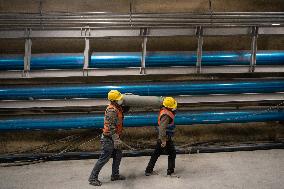
(231207) -- JINPING, Dec. 7, 2023 (Xinhua) -- This photo taken on Nov. 7, 2023 shows workers transporting a gas argon tank at the Deep Underground and Ultra-low Radiation Background Facility for Frontier Physics Experiments (DURF) in Liangshan Yi Autonomous Prefecture of southwest China's Sichuan Province. A 2,400-meter-deep physics laboratory in southwest China's Sichuan Province became operational on Thursday, making it the deepest and largest underground lab in the world. Scientists believe the laboratory provides a "clean" space for them to pursue the invisible substance known as dark matter. They said the extreme depth helps block most cosmic rays that mess with the observation. The Deep Underground and Ultra-low Radiation Background Facility for Frontier Physics Experiments (DURF) is located beneath Jinping Mountain in Sichuan's Liangshan Yi Autonomous Prefecture. The DURF, with a total room capacity of 330,000 cubic meters, is the second phase of China Jinping Underground Laboratory. It started constru

  •  
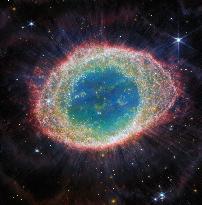
James Webb View Of The Ring Nebula

James Webb View Of The Ring Nebula

The NASA/ESA/CSA James Webb Space Telescope has observed the well-known Ring Nebula with unprecedented detail. Formed by a star throwing off its outer layers as it runs out of fuel, the Ring Nebula is an archetypal planetary nebula. Also known as M57 and NGC 6720, it is both relatively close to Earth at roughly 2,500 light-years away. This new image provides unprecedented spatial resolution and spectral sensitivity. For example, the intricate details of the filament structure of the inner ring are particularly visible in this dataset. There are some 20,000 dense globules in the nebula, which are rich in molecular hydrogen. In contrast, the inner region shows very hot gas. The main shell contains a thin ring of enhanced emission fromcarbon-based molecules known as polycyclic aromatic hydrocarbons (PAHs). Roughly ten concentric arcs are located just beyond the outer edge of the main ring. The arcs are thought to originate from the interaction of the central star with a low-mass companion orbiting at a distance

  •  
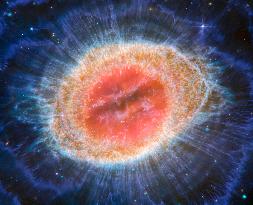
James Webb View Of The Ring Nebula

James Webb View Of The Ring Nebula

The NASA/ESA/CSA James Webb Space Telescope has observed the well-known Ring Nebula with unprecedented detail. Formed by a star throwing off its outer layers as it runs out of fuel, the Ring Nebula is an archetypal planetary nebula. Also known as M57 and NGC 6720, it is both relatively close to Earth at roughly 2,500 light-years away. This new image provides unprecedented spatial resolution and spectral sensitivity. In particular, Webb’s MIRI (Mid-InfraRed Instrument) reveals particular details in the concentric features in the outer regions of the nebulae’s ring (right). There are some 20,000 dense globules in the nebula, which are rich in molecular hydrogen. In contrast, the inner region shows very hot gas. The main shell contains a thin ring of enhanced emission fromcarbon-based molecules known as polycyclic aromatic hydrocarbons (PAHs). Roughly ten concentric arcs located just beyond the outer edge of the main ring. The arcs are thought to originate from the interaction of the central star with a low-mass

  •  
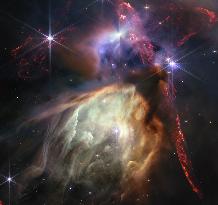
Webb Celebrates First Year of Science With Close-up on Birth of Sun-like Stars

Webb Celebrates First Year of Science With Close-up on Birth of Sun-like Stars

Handout - The first anniversary image from NASA’s James Webb Space Telescope displays star birth like it’s never been seen before, full of detailed, impressionistic texture. The subject is the Rho Ophiuchi cloud complex, the closest star-forming region to Earth. It is a relatively small, quiet stellar nursery, but you’d never know it from Webb’s chaotic close-up. Jets bursting from young stars crisscross the image, impacting the surrounding interstellar gas and lighting up molecular hydrogen, shown in red. Some stars display the telltale shadow of a circumstellar disk, the makings of future planetary systems. July 12, 2023. Photo by Klaus Pontoppidan/STScI, ASA, ESA, CSA /NASA via ABACAPRESS.COM

  •  
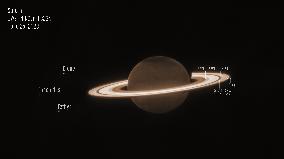
Saturn Captured By James Webb Space Telescope

Saturn Captured By James Webb Space Telescope

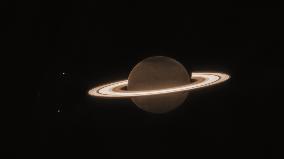
This image shows Saturn and some of its moons, captured by the James Webb Space Telescope’s (JWST) NIRCam instrument on June 25, 2023. In this monochrome image, NIRCam filter F323N (3.23 microns) was color mapped with an orange hue. JWST turned to the ringed world Saturn in June 2023 to conduct a deep search for new ring structure and faint moons. Saturn itself appears to extremely dark at the infrared wavelengths sensed by JWST’s Near-Infrared Camera (NIRCam), as methane gas absorbs almost all of the sunlight falling on the atmosphere. However, the icy rings stay relatively bright, leading to the unusual appearance of Saturn in the JWST image. Several very deep Saturn exposures taken together with this image were designed to test JWST’s capacity to detect faint moons around the planet and its bright rings. Any newly discovered moons would be important dynamical tracers of the current Saturn system as well as its past history. This context image clearly shows details within the ring system, along with many of

  •  
Saturn Captured By James Webb Space Telescope

Saturn Captured By James Webb Space Telescope

This image shows Saturn and some of its moons, captured by the James Webb Space Telescope’s (JWST) NIRCam instrument on June 25, 2023. In this monochrome image, NIRCam filter F323N (3.23 microns) was color mapped with an orange hue. JWST turned to the ringed world Saturn in June 2023 to conduct a deep search for new ring structure and faint moons. Saturn itself appears to extremely dark at the infrared wavelengths sensed by JWST’s Near-Infrared Camera (NIRCam), as methane gas absorbs almost all of the sunlight falling on the atmosphere. However, the icy rings stay relatively bright, leading to the unusual appearance of Saturn in the JWST image. Several very deep Saturn exposures taken together with this image were designed to test JWST’s capacity to detect faint moons around the planet and its bright rings. Any newly discovered moons would be important dynamical tracers of the current Saturn system as well as its past history. This context image clearly shows details within the ring system, along with many of

  •  
View Of Comet Helps Solve Mystery Of Earth's Abundant Water

View Of Comet Helps Solve Mystery Of Earth's Abundant Water

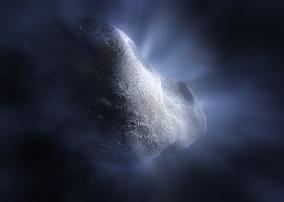
Handout - This artist’s concept of Comet 238P/Read shows the main belt comet sublimating—its water ice vaporising as its orbit approaches the Sun. This is significant, as the sublimation is what distinguishes comets from asteroids, creating their distinctive tail and hazy halo, or coma. The James Webb Space Telescope’s detection of water vapor at Comet Read is a major benchmark in the study of main belt comets, and in the broader investigation of the origin of Earth’s abundant water. NASA's James Webb Space Telescope has enabled another long-sought scientific breakthrough, this time for solar system scientists studying the origins of Earth's abundant water. Using Webb's NIRSpec (Near-Infrared Spectrograph) instrument, astronomers have confirmed gas – specifically water vapor – around a comet in the main asteroid belt for the first time, indicating that water ice from the primordial solar system can be preserved in that region. Comet Read is a main belt comet – an object that resides in the main asteroid belt

  •  
View Of Comet Helps Solve Mystery Of Earth's Abundant Water

View Of Comet Helps Solve Mystery Of Earth's Abundant Water

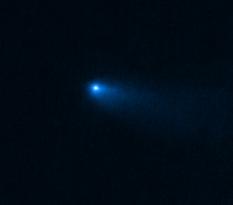
Handout - This image of Comet 238P/Read was captured by the NIRCam (Near-Infrared Camera) instrument on NASA’s James Webb Space Telescope on September 8, 2022. It displays the hazy halo, called the coma, and tail that are characteristic of comets, as opposed to asteroids. The dusty coma and tail result from the vaporization of ices as the Sun warms the main body of the comet. NASA's James Webb Space Telescope has enabled another long-sought scientific breakthrough, this time for solar system scientists studying the origins of Earth's abundant water. Using Webb's NIRSpec (Near-Infrared Spectrograph) instrument, astronomers have confirmed gas – specifically water vapor – around a comet in the main asteroid belt for the first time, indicating that water ice from the primordial solar system can be preserved in that region. Comet Read is a main belt comet – an object that resides in the main asteroid belt but which periodically displays a halo, or coma, and tail like a comet. Main belt comets themselves are a fair

  •  
CHINA-FAST TELESCOPE-MILKY WAY-DETAILS (CN)

CHINA-FAST TELESCOPE-MILKY WAY-DETAILS (CN)

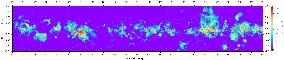
(221211) -- GUIYANG, Dec. 11, 2022 (Xinhua) -- This photo shows the distribution of hydrogen gas in interstellar space of the Milky Way revealed by China's Five-hundred-meter Aperture Spherical Radio Telescope (FAST). TO GO WITH "China's FAST telescope reveals unprecedented details of Milky Way" (Xinhua)

  •  
CHINA-FAST TELESCOPE-MILKY WAY-DETAILS (CN)

CHINA-FAST TELESCOPE-MILKY WAY-DETAILS (CN)

(221211) -- GUIYANG, Dec. 11, 2022 (Xinhua) -- This photo shows the distribution of ionized gas in interstellar space of the Milky Way revealed by China's Five-hundred-meter Aperture Spherical Radio Telescope (FAST). TO GO WITH "China's FAST telescope reveals unprecedented details of Milky Way" (Xinhua)

  •  

U.S. selective in imposing sanctions on Russia, showing double standards: experts

STORY: U.S. selective in imposing sanctions on Russia, showing double standards: experts DATELINE: March 15, 2022 LENGTH: 0:01:19 LOCATION: Beirut/Islamabad CATEGORY: POLITICS SHOTLIST: 1. SOUNDBITE 1 (Arabic): NAJIB MALAEB, Beirut-based security analyst and commentator 2. SOUNDBITE 2 (English): NAJMA MINHAS, Editor at Global Village Space in Pakistan STORYLINE: Since the start of Russia's special military operation in Ukraine, Western countries have imposed batches of sanctions on Russia. Analysts have warned of potential huge consequences and spillovers, and some have raised doubts over the specific sectors in Russia subject to the sanctions by the U.S. SOUNDBITE 1 (Arabic): NAJIB MALAEB, Beirut-based security analyst and commentator "We saw that sanctions were on some Russian banks, not all banks. Banks that cover proceeds from oil and gas in Russia were not subject to SWIFT sanctions. They (the U.S.) were being selective in imposing sanctions in respect for the interests of the U.S. and Europe." SOUN

  •  
MM Catalyst, an auxiliary catalyst device developed by Haiba Iron Works in collaboration with Nichidai Filter

MM Catalyst, an auxiliary catalyst device developed by Haiba Iron Works in collaboration with Nichidai Filter

Haiba Iron Works (Kakegawa City, Shizuoka Prefecture), in cooperation with Nichidai Filter (Ujitawara Town, Kyoto Prefecture), a stainless steel diffusion bonding (sintering) company, has developed an auxiliary catalytic converter "MM catalyst" that shortens the activation time of the main catalyst for exhaust gas purification by about 40%. The MM catalyst is manufactured by loading precious metals onto a structure made of sintered stainless steel wire mesh. Compared to the honeycomb structure that is commonly used in catalysts, the reaction space is more complex and the contact efficiency of exhaust gas is improved. Noboru Ishizawa, director of the technology department at Haiba Iron Works, said, "We will further refine our technology through repeated tests using actual machines (for practical use). On July 10, 2019, the head office of Haruba Ironworks in Kakegawa City, Shizuoka Prefecture.

  •  
ATC Space, new production hall

ATC Space, new production hall

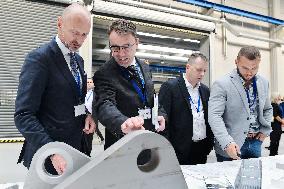
Czech company ATC Space, subsidiary of German aircraft engine and gas turbine parts maker Aerotech Peissenberg (ATP), opened new production hall in Klatovy, Czech Republic, on November 1, 2019. On the photo are seen Chairman of the Board of MT Aerospace Hans Steininger, left, and Czech Transport Minister Vladimir Kremlik, 2nd from left. (CTK Photo/Miroslav Chaloupka)

  •  
Vladimir Kremlik

Vladimir Kremlik

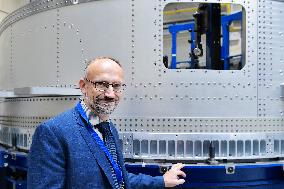
Czech company ATC Space, subsidiary of German aircraft engine and gas turbine parts maker Aerotech Peissenberg (ATP), opened new production hall in Klatovy, Czech Republic, on November 1, 2019. On the photo right there is Czech Transport Minister Vladimir Kremlik. (CTK Photo/Miroslav Chaloupka)

  •  
ATC Space, new production hall

ATC Space, new production hall

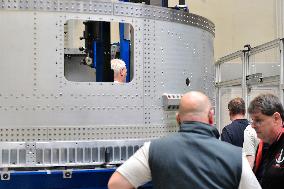
Czech company ATC Space, subsidiary of German aircraft engine and gas turbine parts maker Aerotech Peissenberg (ATP), opened new production hall in Klatovy, Czech Republic, on November 1, 2019. (CTK Photo/Miroslav Chaloupka)

  •  
ATC Space, new production hall

ATC Space, new production hall

Czech company ATC Space, subsidiary of German aircraft engine and gas turbine parts maker Aerotech Peissenberg (ATP), opened new production hall in Klatovy, Czech Republic, on November 1, 2019. (CTK Photo/Miroslav Chaloupka)

  •  
Pavel Cizek

Pavel Cizek

Czech company ATC Space, subsidiary of German aircraft engine and gas turbine parts maker Aerotech Peissenberg (ATP), opened new production hall in Klatovy, Czech Republic, on November 1, 2019. On the photo Pilsen Region Deputy Governor Pavel Cizek. (CTK Photo/Miroslav Chaloupka)

  •  
Vladimir Kremlik

Vladimir Kremlik

Czech company ATC Space, subsidiary of German aircraft engine and gas turbine parts maker Aerotech Peissenberg (ATP), opened new production hall in Klatovy, Czech Republic, on November 1, 2019. On the photo is seen Czech Transport Minister Vladimir Kremlik. (CTK Photo/Miroslav Chaloupka)

  •  
ATC Space, new production hall

ATC Space, new production hall

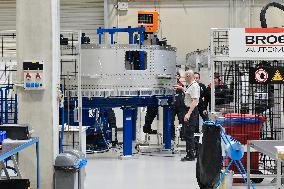
Czech company ATC Space, subsidiary of German aircraft engine and gas turbine parts maker Aerotech Peissenberg (ATP), opened new production hall in Klatovy, Czech Republic, on November 1, 2019. (CTK Photo/Miroslav Chaloupka)

  •  
Vladimir Kremlik

Vladimir Kremlik

Czech company ATC Space, subsidiary of German aircraft engine and gas turbine parts maker Aerotech Peissenberg (ATP), opened new production hall in Klatovy, Czech Republic, on November 1, 2019. On the photo is seen Czech Transport Minister Vladimir Kremlik. (CTK Photo/Miroslav Chaloupka)

  •  
ATC Space, new production hall

ATC Space, new production hall

Czech company ATC Space, subsidiary of German aircraft engine and gas turbine parts maker Aerotech Peissenberg (ATP), opened new production hall in Klatovy, Czech Republic, on November 1, 2019. (CTK Photo/Miroslav Chaloupka)

  •  
ATC Space, new production hall

ATC Space, new production hall

Czech company ATC Space, subsidiary of German aircraft engine and gas turbine parts maker Aerotech Peissenberg (ATP), opened new production hall in Klatovy, Czech Republic, on November 1, 2019. (CTK Photo/Miroslav Chaloupka)

  •  
ATC Space, new production hall

ATC Space, new production hall

Czech company ATC Space, subsidiary of German aircraft engine and gas turbine parts maker Aerotech Peissenberg (ATP), opened new production hall in Klatovy, Czech Republic, on November 1, 2019. On the photo are seen Chairman of the Board of MT Aerospace Hans Steininger, left, and Czech Transport Minister Vladimir Kremlik, 2nd from left. (CTK Photo/Miroslav Chaloupka)

  •  
Hayabusa2 space probe project team given prime minister's award

Hayabusa2 space probe project team given prime minister's award

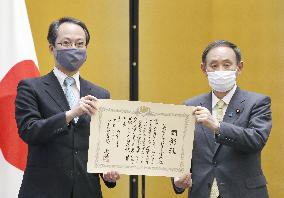
Yuichi Tsuda (L), manager of the Japan Aerospace Exploration Agency's Hayabusa2 space probe project team, poses for a photo in Tokyo on Dec. 17, 2020, along with Japanese Prime Minister Yoshihide Suga, after the team received the prime minister's award for successfully bringing home soil and gas samples from a distant asteroid for research into the origins of life and the evolution of the solar system.

  •  
Japan launches H-2A rocket

Japan launches H-2A rocket

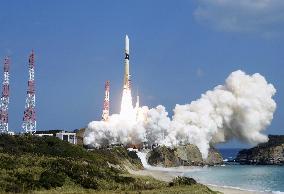
An H-2A rocket carrying an Ibuki-2 greenhouse gas observation satellite is launched from the Tanegashima Space Center in Kagoshima Prefecture, southwestern Japan, on Oct 29, 2018. (Kyodo) ==Kyodo

  •  
Japan launches H-2A rocket

Japan launches H-2A rocket

An H-2A rocket carrying an Ibuki-2 greenhouse gas observation satellite is launched from the Tanegashima Space Center in Kagoshima Prefecture, southwestern Japan, on Oct 29, 2018. (Kyodo) ==Kyodo

  •  
Japan launches H-2A rocket

Japan launches H-2A rocket

An H-2A rocket carrying an Ibuki-2 greenhouse gas observation satellite is launched from the Tanegashima Space Center in Kagoshima Prefecture, southwestern Japan, on Oct 29, 2018. (Kyodo) ==Kyodo

  •  
Japan launches H-2A rocket

Japan launches H-2A rocket

An H-2A rocket carrying an Ibuki-2 greenhouse gas observation satellite is launched from the Tanegashima Space Center in Kagoshima Prefecture, southwestern Japan, on Oct 29, 2018. (Kyodo) ==Kyodo

  •  
Japan launches H-2A rocket

Japan launches H-2A rocket

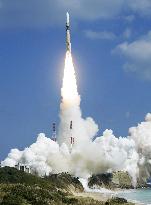
Photo taken from a Kyodo News helicopter shows the launch of an H-2A rocket, carrying an Ibuki-2 greenhouse gas observation satellite, at the Tanegashima Space Center in Kagoshima Prefecture, southwestern Japan, on Oct. 29, 2018. (Kyodo) ==Kyodo

  •  
Japan launches H-2A rocket

Japan launches H-2A rocket

Photo taken from a Kyodo News helicopter shows the launch of an H-2A rocket, carrying an Ibuki-2 greenhouse gas observation satellite, at the Tanegashima Space Center in Kagoshima Prefecture, southwestern Japan, on Oct. 29, 2018. (Kyodo) ==Kyodo

  • Main
  • Top
  • Editorial
  • Creative
  • About Us
  • About ILG
  • Terms of use
  • Company
  • BEHIND
  • Price List
  • Single Plan
  • Monthly Plan
  • Services
  • Shooting
  • Rights Clearance
  • Support
  • FAQ
  • How To Buy
  • Contact Us
  • Become a Partner

© KYODO NEWS IMAGES INC

All Rights Reserved.

  • Editorial
  • Olympics
  • News
  • Sports
  • Japan
  • Tech
  • Royal
  • Disaster
  • NorthKorea
  • Old Japan
  • SNS
  • Creative
  • Food
  • Japan
  • Landscape
  • Animal
  • Popular
  • #Ukraine
  • #Russia
  • #coronavirus
  • #N. Korea
  • #China
  • #Thailand
  • #Ukraine
  • #Russia
  • #coronavirus
  • #N. Korea
  • #China
  • #Thailand
  • Food
  • Japan
  • Landscape
  • Animal
  • Olympics
  • News
  • Sports
  • Japan
  • Tech
  • Royal
  • Disaster
  • NorthKorea
  • Old Japan
  • SNS